Chapter 3: Scenarios & Selection
Eight typical deployment scenarios with real-world installation examples, technical requirements, and success metrics.
3.1 Applicability Boundaries
This guide applies to enterprise buildings, campuses, warehouses, parking structures, retail chains, transportation hubs (non-rail critical), municipal sites, and light industrial facilities. Copper channels must remain within standard distance limits; extreme EMI zones require fiber or shielded solutions. All outdoor deployments must include sealing and surge/grounding provisions.
This guide is not recommended for hazardous explosive zones without certified Ex-rated equipment, ultra-high-security military environments with classified physical separation rules, or long-haul inter-city transmission requiring carrier-grade transport. Key constraints commonly encountered include budget caps, rushed delivery schedules, limited ceiling pathway space, and variable O&M skill levels across sites.
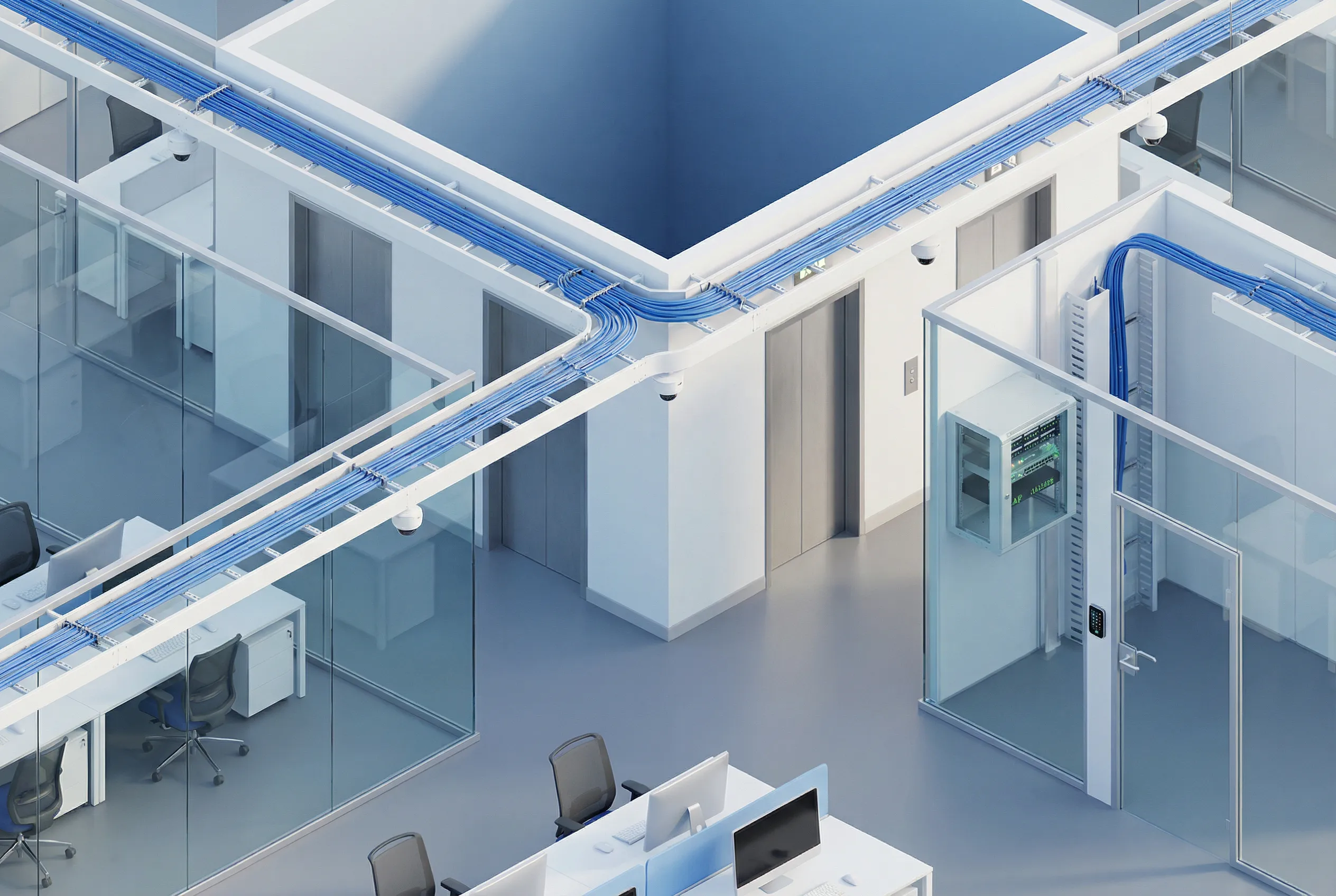
Corporate Office Floors (Indoor, Low EMI)
Cameras cover entrances, corridors, and elevator lobbies. Cabling runs above ceiling trays to IDF closets. The main risk is messy patching and mislabeling due to frequent office reconfigurations. Occupancy changes create recurring reconfiguration needs, making maintainability and documentation more critical than extreme weather hardening. PoE load is moderate, but thermal conditions in small IDF closets can cause switch instability if ventilation is inadequate.
| Requirement | Specification |
|---|---|
| Cable type | Cat6/Cat6A plenum-rated (LSZH where required) |
| Patch cord management | Short cords ≤2 m with horizontal managers |
| Cabinet security | Locked IDF closets with access control |
| Spare capacity | ≥25% spare ports and pathway space |
| Labeling | Consistent scheme aligned with floor plan numbering |
| EMI separation | Avoid parallel runs with high-current feeders |
| VMS alignment | Port labels must match VMS camera mapping |
| Acceptance | Certification reports + as-built drawings required |
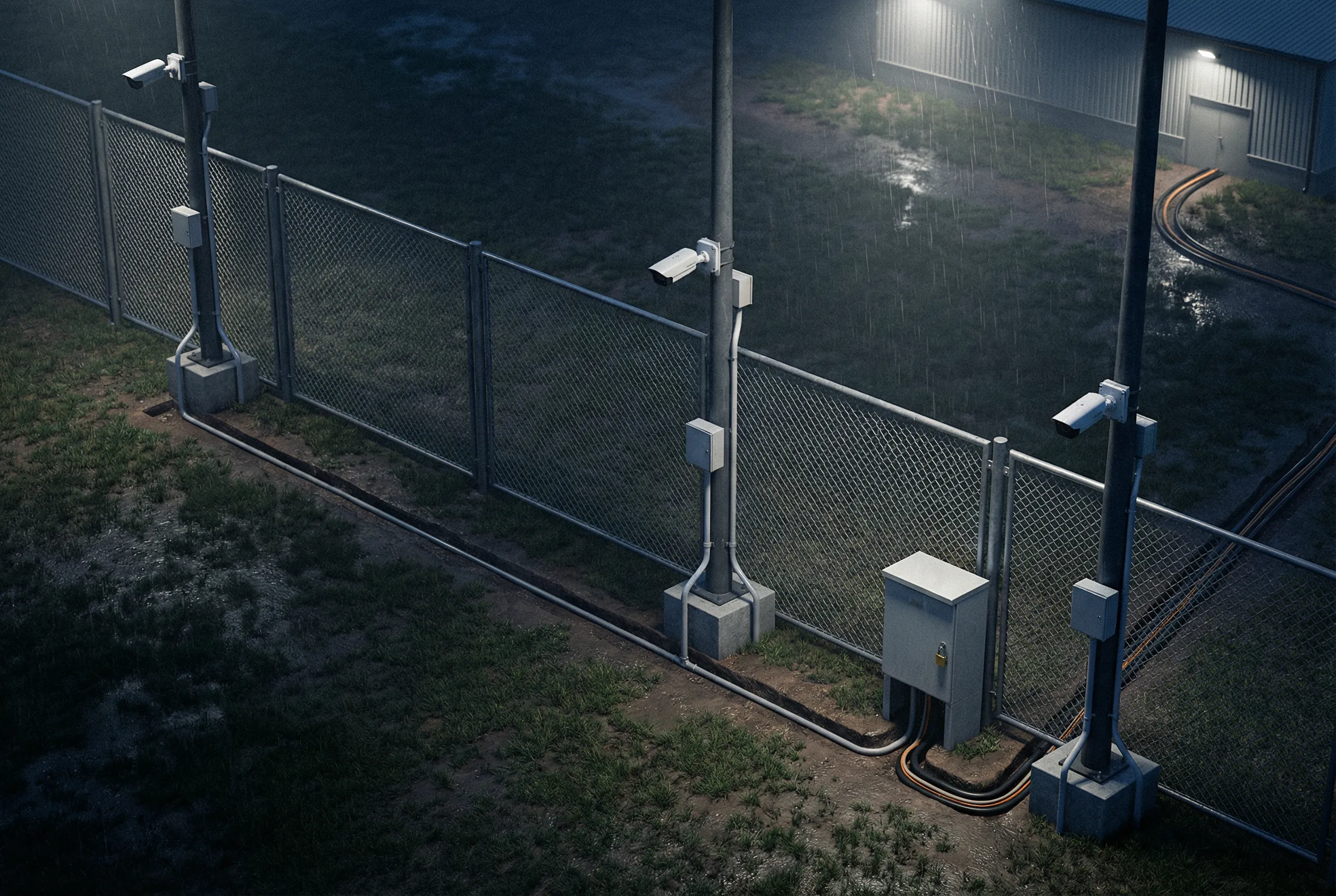
Outdoor Perimeter Fence (High Lightning Risk)
Long outdoor cable runs along fences, poles, and gates present the most challenging environment for surveillance cabling. Distances vary widely; lightning and moisture ingress are the primary failure risks. Physical tampering is common in perimeter deployments — armored conduits should be used where cables are exposed below 3 m, and junction boxes should be mounted out of easy reach. Bandwidth may spike with motion detection at night when IR illumination activates, requiring uplink margin planning.
| Requirement | Specification |
|---|---|
| Backbone medium | Fiber optic to isolate outdoor runs from building ground |
| Cable jacket | Outdoor-rated PE jacket + UV resistance (OSP grade) |
| Enclosures | IP66/67 junction boxes with drip loops at entry points |
| Surge protection | SPDs at building entry and pole bases as applicable |
| Grounding | Equipotential bonding of all metal poles and cabinets |
| Physical security | Lockable cabinets with tamper alarm (optional) |
| Spare capacity | 25–50% spare fiber cores for repairs and expansion |
| Documentation | Pole IDs with GPS/zone references in as-built drawings |
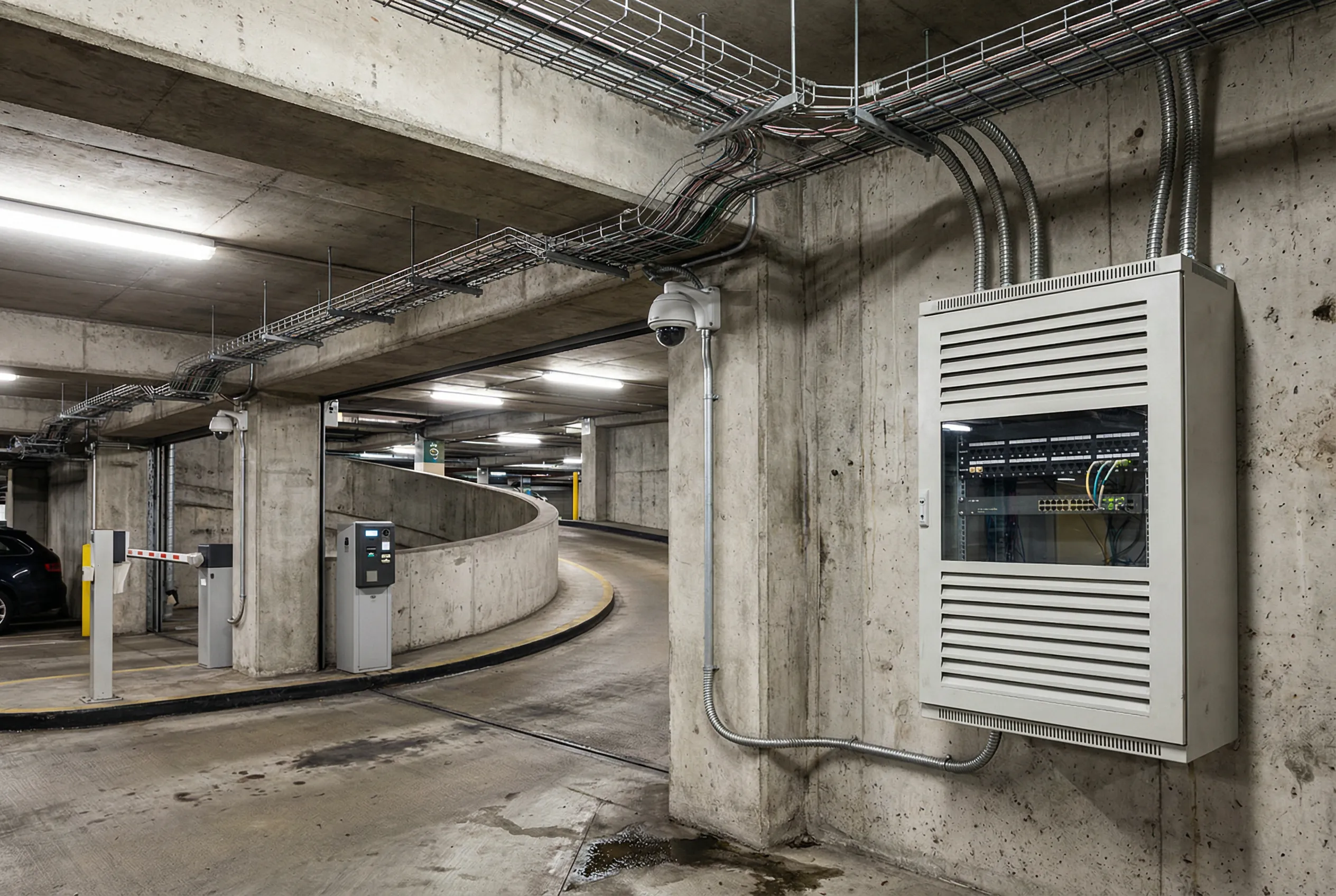
Parking Garage (Dust, Exhaust, Low Light)
Cameras at ramps, entrances, and payment points operate in a harsh environment where dust and vibration can loosen terminations over time. IR illumination significantly increases PoE draw at night. Pathways often share space with power and ventilation systems, increasing EMI and physical damage risks. Maintenance windows are limited due to 24/7 vehicle access, so the design must prioritize quick component swap without extended downtime.
| Requirement | Specification |
|---|---|
| Switch grade | Industrial-rated switches (IP30 minimum) in local cabinets |
| Mechanical protection | Strain relief + vibration-resistant mounting for all drops |
| PoE budget | Include night IR and heater draw in worst-case calculation |
| Impact protection | Protect cables from vehicle impact zones with conduit |
| EMI separation | Minimum 300 mm from power feeders and motor cables |
| Labeling | Clear labels with accessible service loops at each drop |
| Thermal monitoring | Cabinet temperature sensor with alert threshold |
| Fire safety | Fire-stopping at all penetrations per local code |
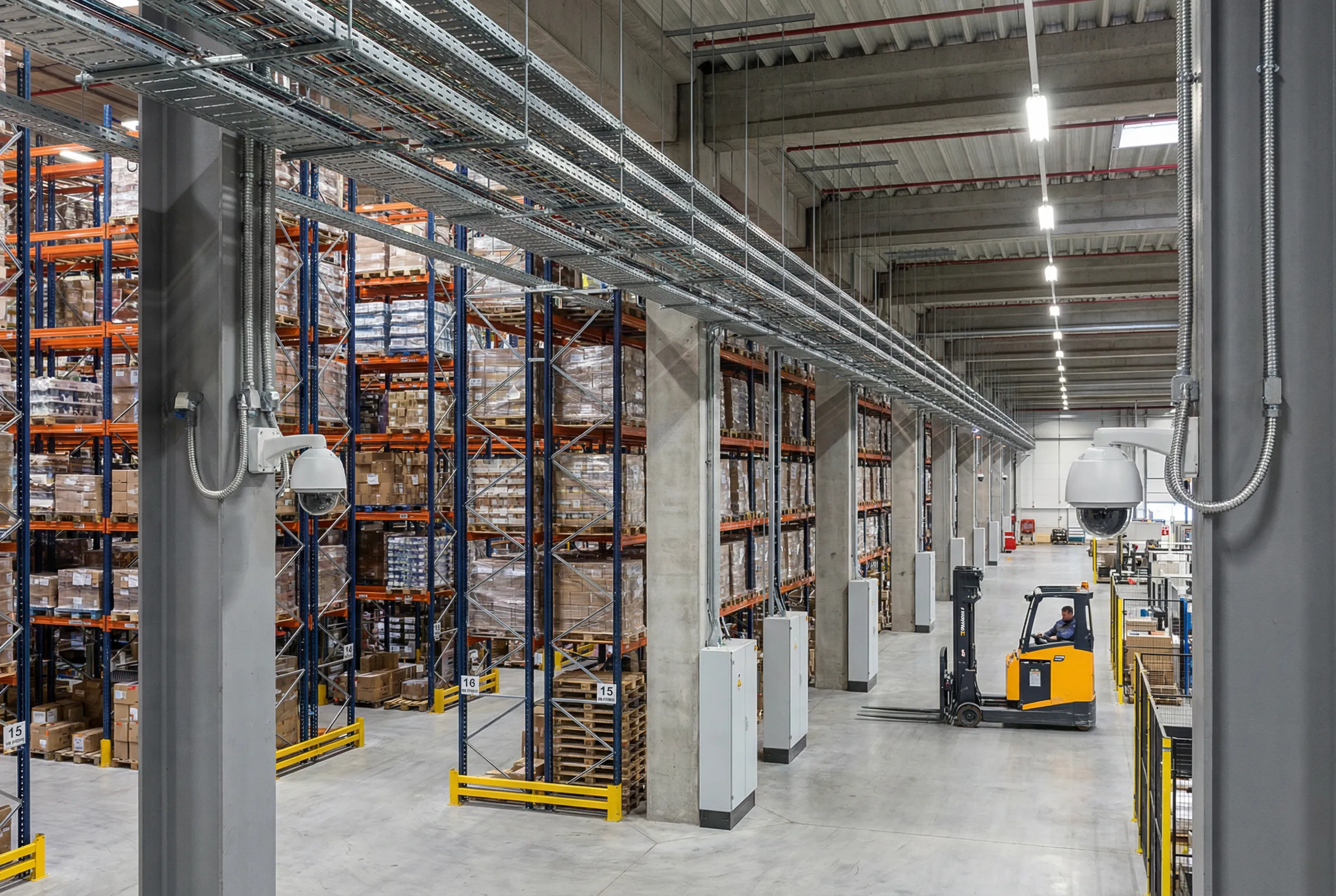
Warehouse with High Racks (Long Sightlines)
Cameras mounted at 8–15 m height on structural beams provide wide coverage of rack aisles. Lift and forklift operations create cable snagging risks if routing is not properly protected with conduit sleeves. Dust accumulation affects connectors and cabinet ventilation filters, requiring a periodic cleaning plan. The large floor area means long distances between camera clusters, making fiber distribution to zone cabinets the standard approach.
| Requirement | Specification |
|---|---|
| Cable routing | Overhead trays with drop conduits + safety-rated fasteners |
| Service loops | Provide 1 m service loop at each camera mounting point |
| Backbone | Fiber to distribution cabinets across zones (SM preferred) |
| Dust protection | Dust filters on cabinets + quarterly cleaning schedule |
| PoE budget | Include PTZ motor draw and IR illumination margin |
| Zone labeling | Labels aligned with rack aisle numbering system |
| Future expansion | Spare conduits for future aisle additions |
| Lightning protection | Required if metal roof with direct exposure |
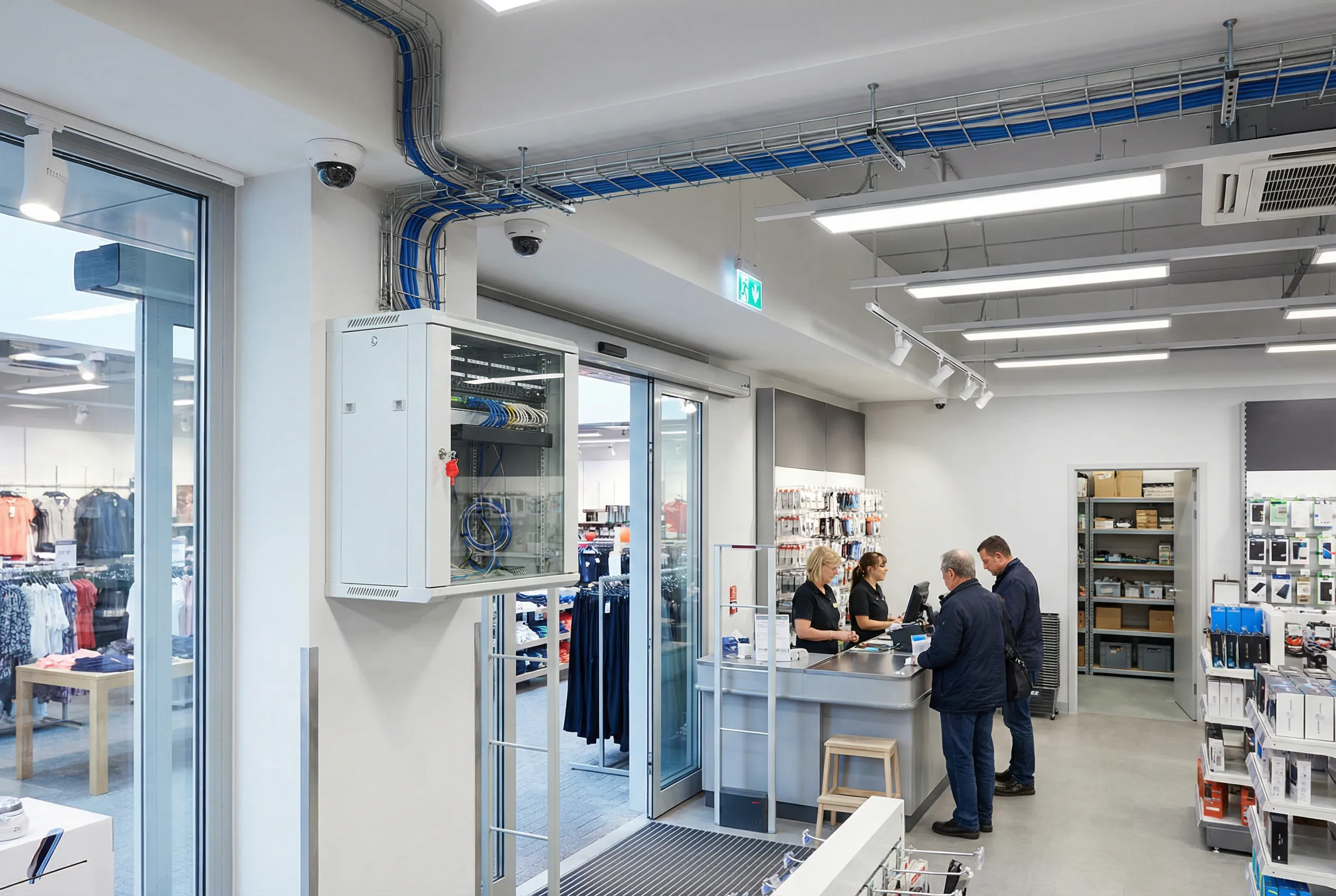
Retail Chain Store (Fast Deployment, Low-Skill O&M)
Multi-site retail deployments demand consistency and repeatability above all else. A standardized BOM and "golden" labeling scheme eliminates variability across hundreds of stores. Staff may inadvertently unplug cables or tamper with equipment, making physical protection and clear labeling critical for maintaining system integrity. Limited room for racks means compact wall-mounted cabinets with lockable doors are the standard enclosure choice.
| Requirement | Specification |
|---|---|
| BOM standardization | Standard kit with "golden" labeling scheme per store type |
| Pre-termination | Pre-terminated assemblies where feasible to reduce install errors |
| Cabinet security | Lockable mini cabinet with tamper seals |
| Remote management | Remote power cycling and monitoring capability |
| Labeling | Printed labels with store ID + camera position code |
| Documentation | Standardized as-built template per store type |
| Spare parts | Standard spare kit stocked at regional depot |
| Acceptance | Remote commissioning checklist + photo evidence |
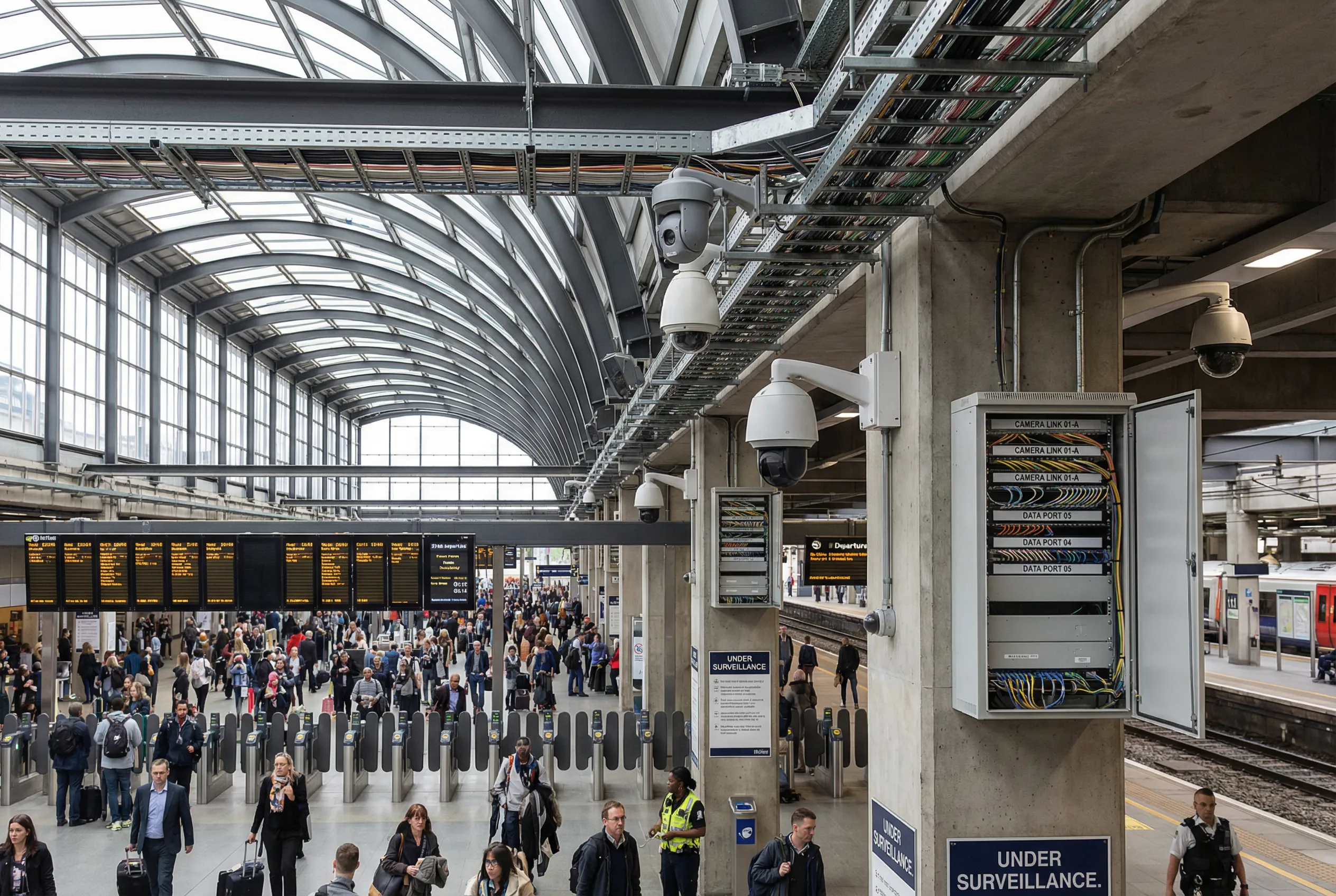
Transportation Hub (High Density, 24/7 Critical)
Train stations, bus terminals, and airports require the highest density of cameras with 24/7 availability. Structural steel and concrete create complex pathway challenges. High passenger throughput means motion-triggered bitrate spikes are constant, requiring uplink bandwidth headroom. The public safety criticality demands redundant uplinks, UPS with extended runtime, and rapid fault response protocols with defined escalation paths.
| Requirement | Specification |
|---|---|
| Uplink redundancy | Dual fiber uplinks with automatic failover (<50 ms) |
| UPS runtime | Minimum 4 hours at full load for critical zones |
| Camera density | High-density PoE switches (48-port, ≥740W budget) |
| Bandwidth margin | Uplink utilization ≤50% at peak motion load |
| Pathway protection | Armored conduit in public-accessible areas |
| Maintenance access | Hot-swap capable switches without service interruption |
| Monitoring | Real-time NMS with port-level alerting and PoE monitoring |
| Grounding | Dedicated ground bus per cabinet, bonded to building earth |
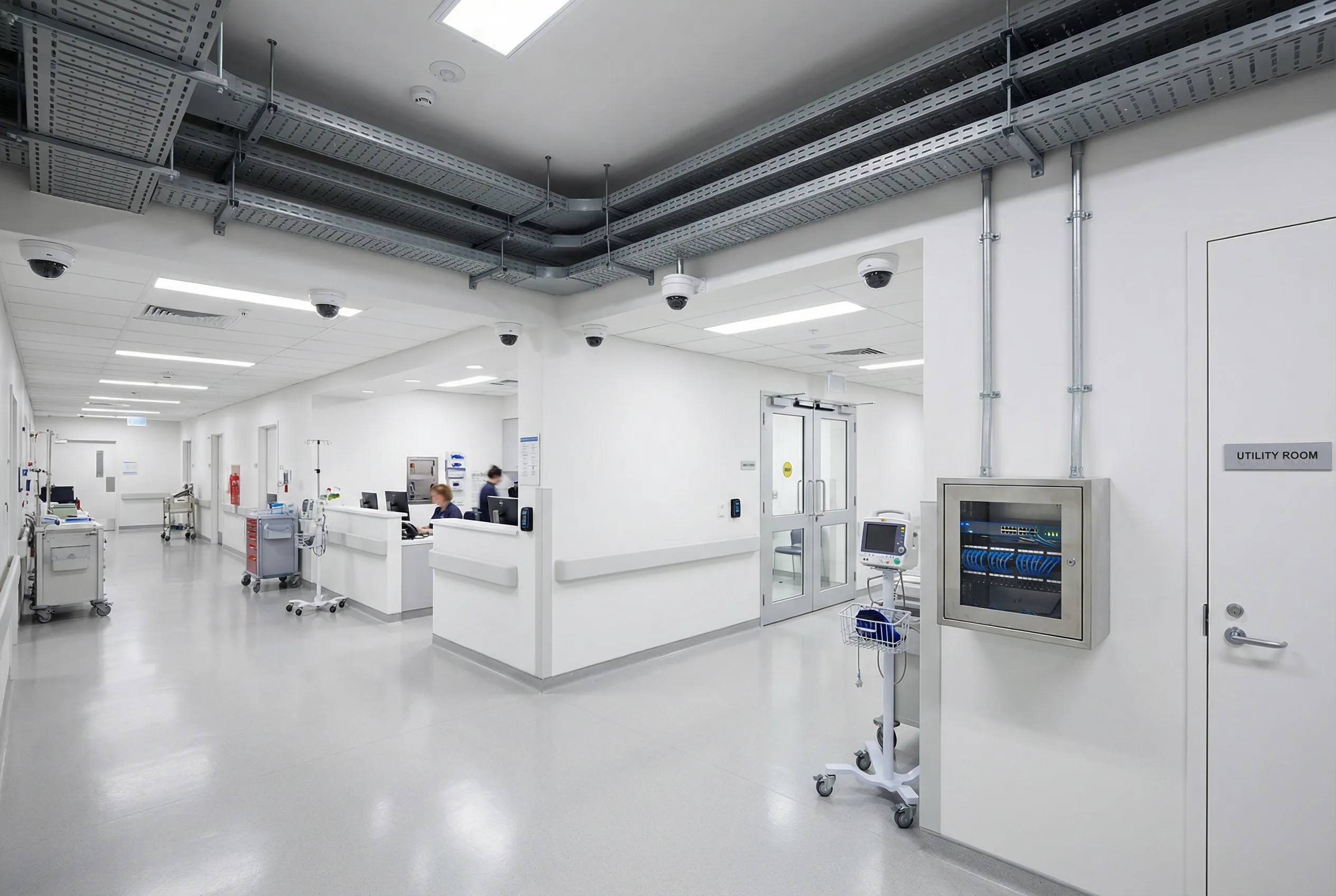
Hospital / Healthcare Facility (Clean Environment, HIPAA-Adjacent)
Healthcare facilities require surveillance cabling that is unobtrusive, cleanable, and compatible with medical equipment EMC requirements. Privacy zones must be clearly defined and enforced at the VMS level, with cabling documentation supporting audit trails. The clean environment demands LSZH cables and flush-mounted conduit runs. Infection control areas may restrict access for maintenance, requiring longer service loops and accessible junction points outside restricted zones.
| Requirement | Specification |
|---|---|
| Cable jacket | LSZH (Low Smoke Zero Halogen) throughout |
| EMC compliance | Separation from medical imaging equipment ≥1 m |
| Privacy zones | Documented no-camera zones in as-built drawings |
| Pathway aesthetics | Flush conduit or ceiling void routing, no exposed trays in patient areas |
| Access control | Network cabinet in non-patient utility room with key access |
| Maintenance access | Service loops outside restricted zones for easy access |
| Cleaning compatibility | IP-rated junction boxes compatible with cleaning agents |
| Documentation | Privacy zone map + camera coverage map for compliance audit |
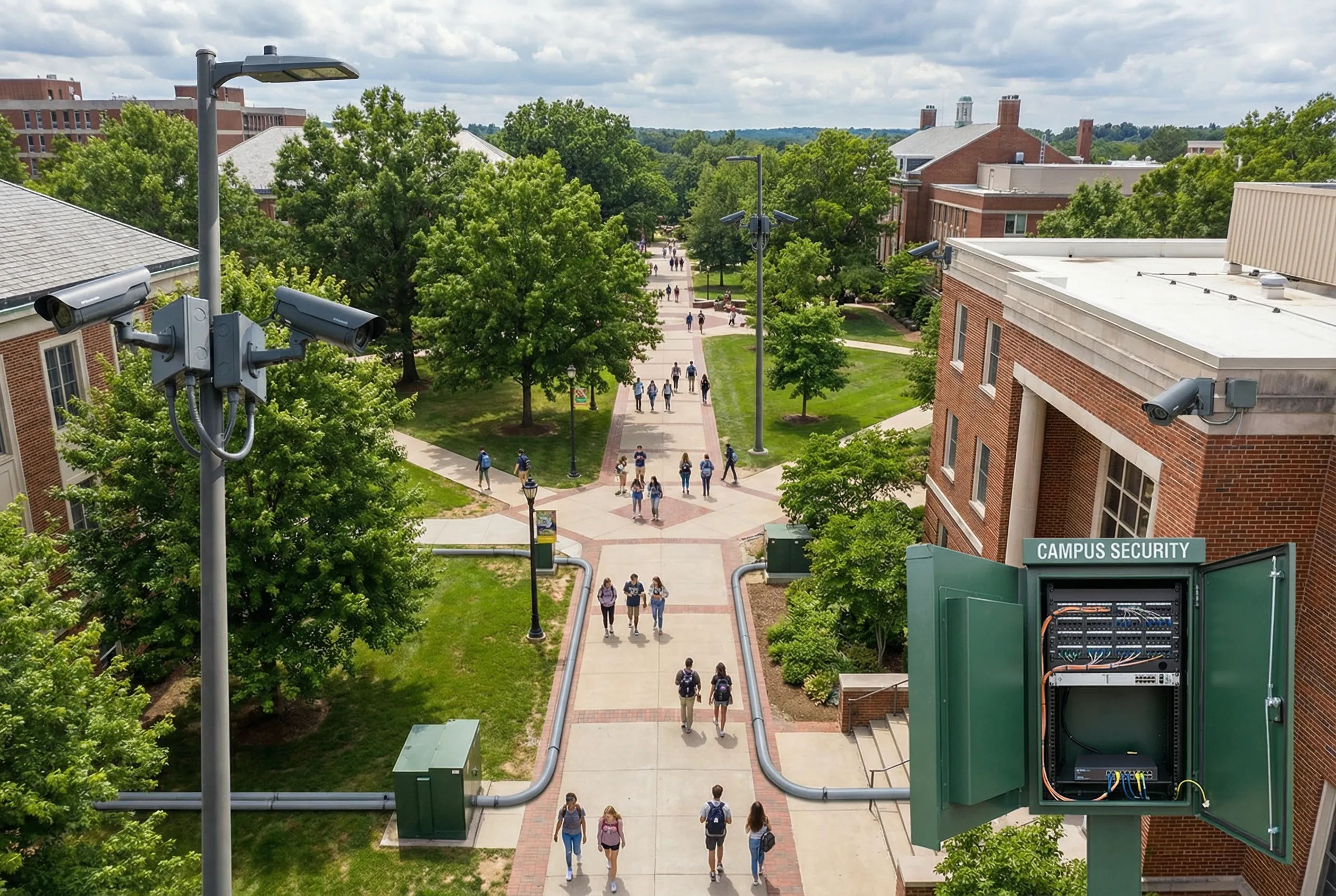
University Campus (Outdoor + Indoor Mixed, Large Scale)
University campuses combine outdoor pedestrian areas, parking lots, building entrances, and indoor corridors into a single large-scale surveillance network. Fiber backbone runs between buildings are mandatory due to distances and lightning isolation requirements. The diverse environment requires different cabling strategies per zone: outdoor-rated fiber in buried conduit for inter-building runs, Cat6A for indoor drops, and weatherproof junction boxes for pole-mounted cameras. Phased expansion over academic years is common, requiring robust spare capacity planning.
| Requirement | Specification |
|---|---|
| Inter-building backbone | Single-mode fiber in buried conduit (OS2, armored where needed) |
| Outdoor drops | Outdoor-rated Cat6A or fiber to pole cameras |
| Lightning isolation | Fiber between buildings eliminates ground loop risk |
| Spare conduits | Minimum 2 spare conduits per inter-building route |
| Zone cabinets | Weatherproof outdoor cabinets at building entries |
| Phased expansion | Numbered spare ports and fiber cores for future phases |
| Documentation | Campus-wide cable schedule with building/zone/port mapping |
| Grounding | SPDs at all building entry points for outdoor fiber runs |